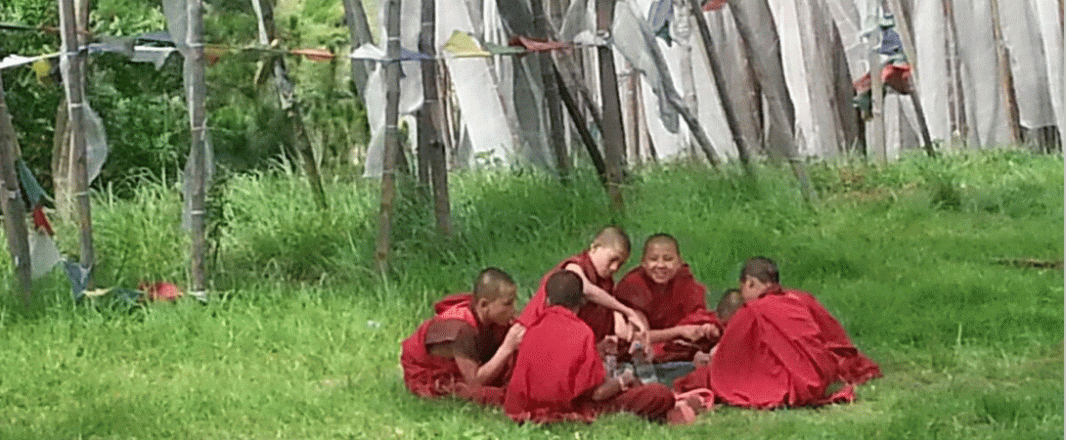
At Dochula Pass, 3,000m above sea level, low clouds partly shroud the 108 stupas that were built to commemorate fallen warriors.
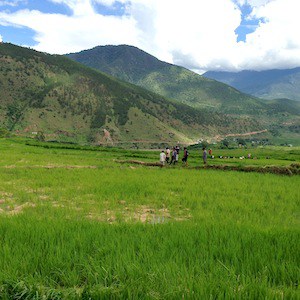
Spectacular scenery
This is the midway point between Thimpu and Punakha Valley, where we are headed on Day 3 of our journey through Bhutan, the Land of Thunder Dragon.
The drive uphill has been smooth despite the condition of the road which is still a work in progress. It takes great skill to negotiate the twists and bends and the numerous trucks and lorries but our driver Ugyen is up to the task.
The scenery is spectacular – pine trees as far as the eye can see, steep ravines plunging down to green valleys below and every now and then, sight of flowing rivers.
Punakha Valley is home to the Fertility Temple, Chimi Lapkhang, built to honour the Divine Madman, Drukpa Kunley, whom I wrote about last week. This is the monk who made the phallus the icon of the area and in Punakha Valley, they really come into their own.
We stop for lunch at a local restaurant that has a great outlook over the rice fields that we will soon be walking through to get to the temple.
It is a lovely walk – a gentle stroll through swaying stalks of rice fields, waving to farmers working their land and watching horses grazing quietly.
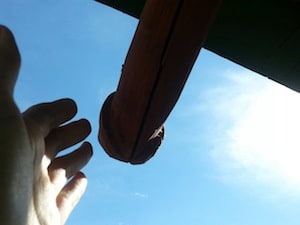
A phallic welcome at the Fertility Temple
At the gateway to the temple, a huge phallus hangs downwards to welcome visitors. I am told it’s good luck to jump and touch it. Anyway, that’s my story and I am sticking to it.
Chimi means “no dog” but in the grounds of the temple, there are a couple of dogs and cats (this the first time I’ve seen a cat in Bhutan and it looked like it owned the place like cats everywhere) sharing the space peacefully with the monks. In the garden, a group of monks are having their music lessons.
As its name implies, this temple is known for helping people make babies and apparently, couples who have their prayers answered name their kid Chimi. I wonder how many Chimis there are.
While fertility is not what I am after in this life, I nevertheless accept a blessing on the head by a monk who wields a wooden phallus.
Our hotel tonight is the Meri which has a superb view of Punakha Valley. It’s clearly made for groups though and it wouldn’t be my first choice of where to stay. (I’d recommend the Hotel Lobesa which opened last October. Run by the same people who operate the Chimi Lapkhang restaurant, it’s got eight beautifully-appointed rooms and knows how to cater to independent travellers.)
I also suggest you don’t bother visiting the new town of Khuruthang, it’s a depressing little place created by someone who decided for some reason to move businesses out of the old town of Punakha (which used to be the capital of Bhutan until 1955) to this area.
However what you must do is visit the Punakha Dzong, a place of great historical and political significance where the first National Assembly was held in 1952.
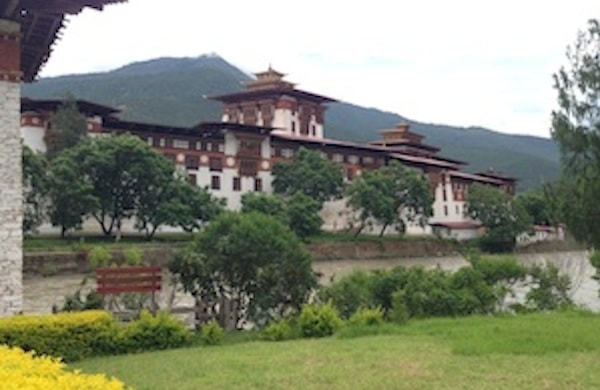
Side view of Punakha Dzong
Built in 1637 under the command of Zhabdrung Ngawang Namgyal, Punakha Dzong sits at the confluence of two rivers, Po Chu (Father River) and Mo Chu (Mother River).
Legend has it that Po Chu and Mo Chu were lovers but one night, Mochu slipped away and Pochu had to run after her and he had to run fast to get her back.
“This is why Po Chu flows faster than Mo Chu today,” says Dorji, who is a great story-teller as all guides should be. “And if you look very hard, you’ll see that the dzong is built on the trunk of a sleeping elephant.”
Bhutanese have great powers of imagination and if you open your mind when you travel through their country, you too can see whatever you wish to see and believe whatever it is you wish to believe.
Our minds filled with phalluses, sleeping elephants and the teachings of Buddha, we decided we needed a coffee break and Dorji suggests Karma Coffee on the way back to Paro.
I recommend this place for great coffee, cakes and oh yes, connectivity. It’s amazing how quickly the conversation stops in a group when there is wifi around and everyone buries their noses in their devices.
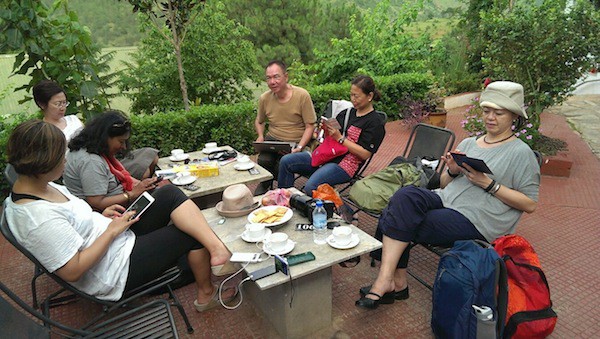
Connectivity over spirituality
I guess that’s the karma of the new traveller of today. We need to tell everyone where we are and what we are doing instantly because the people you’re travelling with, well, they already know so what’s the point …
Me, I am looking forward to staying put for the next three days in Paro where we will visit the Ha Valley, otherwise known as the Secret Shangri-La, and just generally enjoying being there in the moment.